
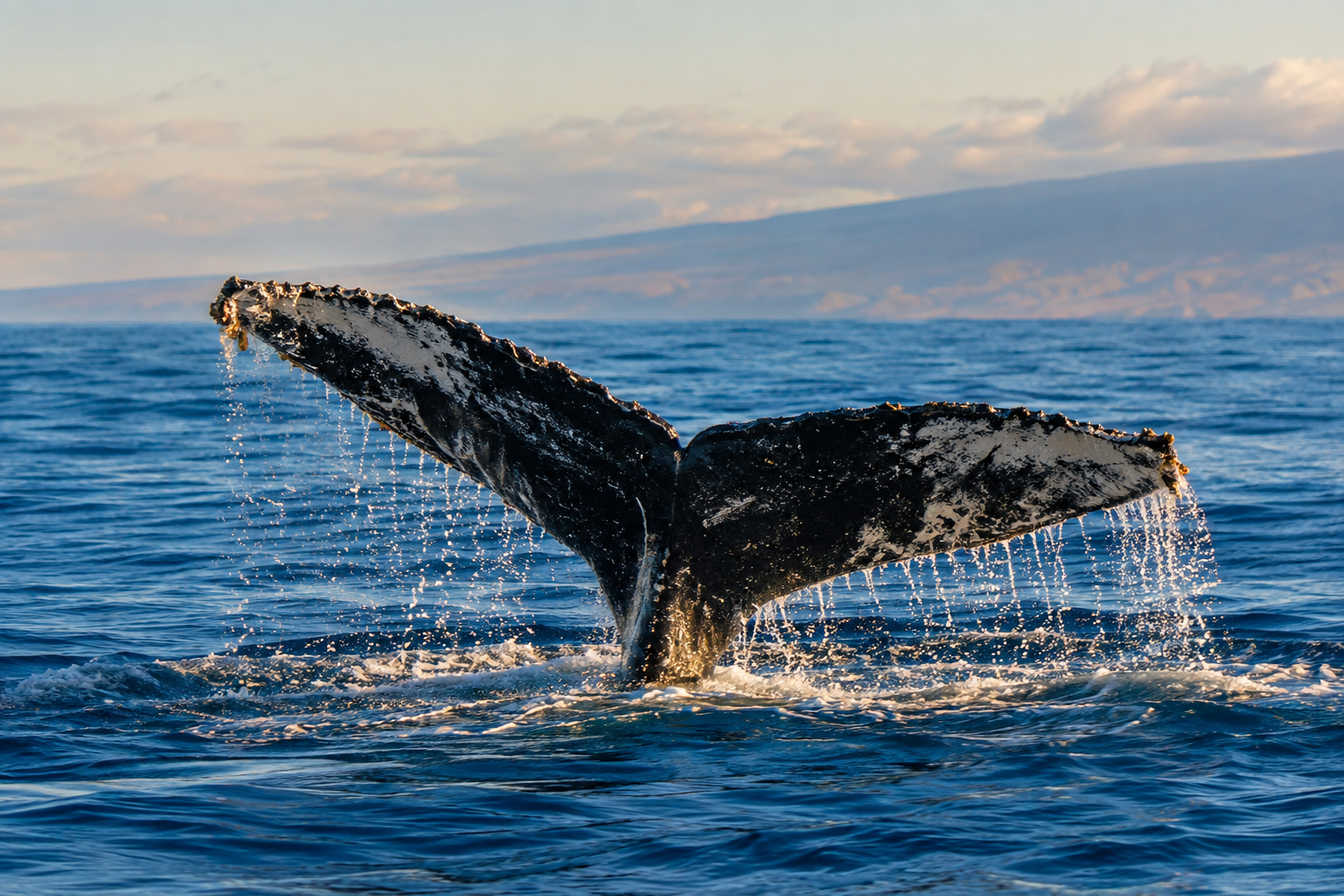
Kona Whale Watching: How to See Humpbacks on the Big Island
Every winter, thousands of humpback whales swim about 3,000 miles from Alaska to spend the season in Hawaiian waters. The Kona coast is one of the easiest places on the Big Island to watch them. Mornings here are usually calm, the water is clear, and the coastline faces west into open ocean, so a spout a mile or two out stands out against the flat blue water.
A lot of our guests see their first whale without leaving the rental. It usually goes like this: the coffee is brewing, someone steps out onto the lanai, and there's a puff of white mist on the horizon. Then a tail. Then everyone is outside in their pajamas.
This guide covers when to come, where to look from shore, how to pick a tour, how to hear whale song for yourself, and the rules that protect the whales. Since January through March is one of the busiest times of year on this coast, we've also included some honest advice on planning a winter stay in Kona.
When Is Whale Season in Kona?
Humpbacks are in Hawaiian waters from about November through April. A few early arrivals show up in late fall, numbers climb through December, and the peak runs from January through March. By early May, nearly all of them have headed back north to feed.
If whales are the main reason for your trip, January and February are your best bet. Volunteers have counted whales from Big Island shore sites every winter since 1996, and those counts show the highest numbers in those two months. By March, sightings on the Kohala coast drop to roughly half.
One detail catches people off guard. The tour season is shorter than the whale season. Most Kona boats start whale trips around mid-December and wrap up in early April. If your trip falls in late November or late April, the whales may be offshore but the tour boats won't be, so plan on watching from land.
Month | What to expect |
November | A few early arrivals. Sightings are possible but hit or miss. |
December | Numbers building. Most whale tours start mid-month. |
January | Peak season. High odds of seeing whales from shore or boat. |
February | Peak season. Often the best month of the year. |
March | Still very good, though numbers taper later in the month. |
April | Decent early in the month, sparse by the end. Tours stop in early April. |
May to October | No humpbacks. Resident whales and dolphins are still offshore (more on that below). |
For a month-by-month look at weather, crowds and prices, see our guide to the best time to visit the Big Island.
Why Humpbacks Come to Hawaii
Humpbacks spend summer feeding in cold, food-rich water near Alaska. In the fall they swim south to Hawaii to mate, give birth and nurse their calves. There's very little for them to eat here, so most of them fast all winter and live off stored fat. What Hawaii gives them instead is warm, sheltered water with few large predators, which makes it a safe place to raise a newborn.
Adults average around 45 feet long, about the length of a city bus. Calves weigh roughly a ton at birth and grow quickly on their mother's milk.
In Hawaiian, the humpback is koholā. Traditional belief connects whales to Kanaloa, god of the ocean, and you'll find the word in place names like Puʻukoholā Heiau on the Kohala coast, which means "hill of the whale."
Commercial whaling pushed humpbacks close to extinction in the last century. After decades of protection, the population that winters in Hawaii recovered enough that in 2016 NOAA decided it no longer needed endangered status. Every humpback here is still protected by federal law, and the rules further down this page apply year-round.
Where to See Whales From Shore in Kona
You don't need a boat to see humpbacks here. On a calm winter morning, whales often pass within a mile or two of the coastline, and anywhere with an open ocean view can work.
Go early if you can. Shore counts on the Big Island record about 50 percent more whales at 8 a.m. than at noon. Part of that is the water itself: it's usually glassier in the morning, and a spout is much easier to see on a flat surface than on whitecaps.
Bring binoculars. A spout two miles out is obvious through binoculars and easy to miss without them.
Look for the blow first. When a humpback exhales, it sends up a column of mist that hangs in the air for a second or two. Once you see one, keep watching that area. Humpbacks usually surface several times in a row before a longer dive, and they can stay down for several minutes, so give it 20 or 30 minutes before you give up.
Spots Close to Our Rentals
Your lanai. If you're staying with us, start here. Both of our properties look out over the ocean, and whale season is when those views earn their keep. Check the water with your morning coffee and again in the late afternoon.
Aliʻi Drive seawall and Kailua Pier. The seawall through Kailua Village gives you a long stretch of open water to scan, and you can grab a coffee or a shave ice while you wait. Many whale tours load at Kailua Pier, so you'll often see boats working offshore, which is a good hint about where the whales are.
Old Kona Airport Beach Park. Just north of town, this park has a long open shoreline, picnic tables and plenty of parking. It's an easy spot for a morning walk with binoculars.
Keauhou Bay. A quieter option south of town. Sit near the mouth of the bay early in the morning, before the day gets busy, and scan the open water beyond it.
The Kohala Coast: Best Odds From Shore
For the highest numbers, drive north. Shore counts on the Kohala coast record two to three times as many whales as other shore sites on the island. Three of the best spots are free and sit within about 10 minutes of each other on Highway 270 north of Kawaihae, roughly an hour from Kailua-Kona.
Puʻukoholā Heiau National Historic Site sits on a rise above Kawaihae Harbor with wide views of the water. The heiau itself is worth an hour of your time, and Spencer Beach Park is right next door if you want to swim afterward.
Lapakahi State Historical Park is near mile marker 14. The viewing area is at the top of a hill about 100 feet up, which lets you see a lot of ocean. It's hot, dry and shadeless, so bring water and a hat.
Kapaʻa Beach Park is just past mile marker 16, down a one-lane road. It's a little lower than Lapakahi, but it has covered picnic pavilions, and you'll appreciate the shade by 10 a.m.
A good plan for this day: leave Kona early, watch until the wind picks up, then stop at Hapuna or Spencer Beach on the way back if the surf is calm. Our guide to the best beaches on the Big Island has more on both.
Kona Whale Watching Tours: How to Choose
Nearly all Big Island whale watching tours leave from Kailua Pier or Honokōhau Harbor, both a short drive from Aliʻi Drive and Keauhou. A few sail from Kawaihae on the Kohala side. Most trips last about two and a half hours, and standard adult tickets generally run somewhere around $125 to $150.
The biggest decision is boat size. Larger catamarans and pontoon boats are steadier, have restrooms and shade, and usually carry a hydrophone so you can hear whale song through a speaker on deck. Many have a naturalist on board. They're the easy pick for families, older travelers and anyone who gets seasick.
Rafts sit low and move fast. You'll be at eye level with the whales and cover more water in the same amount of time. The ride is bumpy and wet, and most raft operators won't take young children, pregnant passengers or anyone with back or neck problems.
Boat size doesn't change how close you get. Federal rules keep every vessel at least 100 yards from a humpback. What changes is the ride.
A few more things to know before you book. Morning trips usually have calmer water than afternoon ones. Some operators offer a sighting guarantee, which means you ride again free if you don't see a whale. For January and February, book at least a week ahead. And try not to schedule your whale trip for your last day. If wind cancels it, you'll want time to rebook.
How to Hear Humpback Whale Song
Male humpbacks sing during breeding season. The songs are long and structured, the males in an area all sing nearly the same one, and that song slowly changes from year to year. Researchers still don't agree on exactly what it's for.
Sound carries a long way underwater, so you don't have to be close to hear it. The easy way is a tour boat with a hydrophone. The more memorable way is to hear it yourself while snorkeling.
On a calm winter morning, if you've seen spouts offshore, swim out to water deeper than about five feet, take a breath and drop a few feet below the surface. Equalize your ears, hold still and listen. On a good day you'll hear groans, whoops and long rising notes, and once you've heard it, you won't forget what it sounds like.
A word of caution. Winter can bring big swells to parts of the Kona coast, including Kahaluʻu and Magic Sands. Only get in when the water is calm, snorkel with a buddy, stick to lifeguarded beaches if you're new, and never stand on coral. Our beginner's guide to snorkeling in Kona covers the rest.
Reading Whale Behavior
Once you know what you're looking at, a sighting gets a lot more interesting.
A breach is the one everyone hopes for. The whale launches most or all of its body out of the water and lands with an enormous splash, and it often does it more than once. A tail slap is what it sounds like: the whale lifts its tail and brings it down hard on the surface, sometimes over and over. In a pec slap, the whale rolls onto its side and slaps one of its pectoral fins on the water. Those fins can be 15 feet long, so you can see the splash from a long way off.
A spyhop is when a whale rises straight up and holds its head above the surface, apparently to take a look around. When a whale arches its back and lifts its tail flukes high into the air, it's usually starting a deeper dive, and you may not see it again for a while.
In peak season you might also catch a competition pod. That's several males chasing one female at speed, shoving and splashing and sometimes breaching as they go. It's loud, rowdy and can last a long time.
The 100-Yard Rule and Other Whale Etiquette
Federal law makes it illegal to approach a humpback whale within 100 yards anywhere within 200 nautical miles of Hawaii. That applies to swimmers, kayakers, paddleboarders and drone pilots as well as boats. Aircraft have to stay 1,000 feet away.
If a whale comes toward you on its own, you haven't done anything wrong. Stay put, stay calm and let it pass. Closing the distance yourself is what's off limits.
Spinner dolphins have their own rule: stay at least 50 yards away. They often rest in Kona's bays during the day after feeding offshore all night, and people chasing them cuts into that rest.
If you see a whale tangled in fishing line or one that looks injured, don't try to help it yourself. Note the location and call the NOAA Marine Wildlife Hotline at 1-888-256-9840. It's a good number to save in your phone before you head out.
Volunteer for the Sanctuary Ocean Count
If your dates line up, you can spend a morning counting whales for science. The Sanctuary Ocean Count, run by NOAA's Hawaiian Islands Humpback Whale National Marine Sanctuary, takes place on the last Saturday of January, February and March, from 8 a.m. to about noon, at shore sites on the Big Island, Oʻahu and Kauaʻi.
Visitors are welcome to sign up. Registration opens on the first Monday of each count month and spots fill quickly, so register the day it opens at oceancount.org. Your tallies join a data set volunteers have been building for 30 years.
Whales in Kona Outside Humpback Season
Humpbacks are gone by May, but Kona has something unusual going for it. The ocean floor drops off steeply close to shore here, so deep water is only a short boat ride away, and that deep water is home to species most visitors never hear about. Short-finned pilot whales, false killer whales, sperm whales and several kinds of beaked whales all live off this coast, and some of them stay year-round.
A few operators run offshore trips out of Honokōhau Harbor from spring through fall to look for them. These trips go farther out than a humpback tour, so the ocean can be rougher, and they usually have minimum ages. If you're visiting in summer and still want to see whales, this is how you do it.
Planning a Whale Season Stay in Kona
January through March is one of the busiest stretches of the year on the Kona coast, especially around the holidays, Presidents' Day weekend and spring break. Flights, tours and ocean-view rentals fill up early. If you have your heart set on February, start looking in summer or early fall.
Plan for at least five nights. Winter weather in Kona is usually pleasant, but a windy day or a high-surf advisory can cancel a boat trip, and a few extra days give you room to rebook.
Here's a simple whale-focused plan. Spend your first morning on the lanai and along the Aliʻi Drive seawall, getting your eyes used to spotting spouts. Book a morning boat for day two or three. Save another early morning for the drive to Puʻukoholā Heiau and Kapaʻa Beach Park, and swim at Spencer Beach on the way home. Fill your afternoons however you like, whether that's a Kona coffee farm, the manta ray night snorkel, or a nap.
Pack a light windbreaker for the boat, since it can feel cool on the water once you're wet and moving. If you're prone to seasickness, take medication before the trip, not after you start feeling it. And bring reef-safe sunscreen, because Hawaii bans sunscreens containing oxybenzone and octinoxate.
Winter has other perks, too. Kona coffee harvest runs into the winter months, the manta rays are here all year, and clear winter nights are great for stargazing from the lanai.
Why an Ocean-View Rental Makes Whale Season Better
A boat tour gives you two and a half hours with the whales. An ocean-view rental gives you every morning and every evening of your trip.
You can drink your coffee on the lanai and watch for spouts before most of the island is awake. You can come back from the beach mid-afternoon and check the water again. When a whale breaches at sunset, you're already sitting down with dinner.
A full kitchen helps more than you'd think. Whale tours and shore watching are best early, and it's much easier to get out the door at 7 a.m. with breakfast made at home than to hunt for a restaurant that's open.
Our rentals on Aliʻi Drive and in Keauhou put you close to Kailua Pier, Honokōhau Harbor and Keauhou Bay, so the boats are only minutes away and the Kohala coast is an easy morning drive.
Winter dates are the first to go. If whale season is on your list, check our calendar now, and book directly with us to claim your 5% discount.
Check availability for whale season →
Kona Whale Watching FAQ
When is whale watching season in Kona? Humpbacks are in Hawaiian waters from about November through April, with the peak from January through March. Most Kona whale watching tours run from mid-December to early April.
What is the best month to see whales on the Big Island? January and February. Long-term shore counts show the highest numbers in those two months, and March is still good.
Can you see humpback whales from shore in Kona? Yes. On calm mornings, whales are often visible from the Kona coastline, including the Aliʻi Drive seawall, Old Kona Airport Beach Park and oceanfront lanais. The Kohala coast north of Kawaihae has the highest shore sighting numbers on the island.
How much does a whale watching tour in Kona cost? Most standard 2.5-hour tours cost around $125 to $150 per adult, with lower prices for children. Prices vary by operator and boat type.
Can you swim with humpback whales in Hawaii? No. Federal law prohibits approaching humpbacks within 100 yards, whether by boat, kayak, paddleboard, drone or swimming.
Are there whales in Kona in the summer? Humpbacks leave by May, but pilot whales, false killer whales, sperm whales and other deep-water species live off the Kona coast. Some operators run offshore trips from spring through fall to find them.
Is Kona or Maui better for whale watching? Maui has the highest concentration of humpbacks in Hawaii, especially in the channel between Maui, Lānaʻi and Molokaʻi. Kona still has excellent whale watching in calm leeward water, plus resident deep-water whales you can look for year-round.